

Lotty Rosenfeld. ‘By Pass’
Exhibition guide to the audiovisual works
A key figure in Latin American video art, Lotty Rosenfeld (Santiago de Chile, 1943–2020) created a deeply singular body of work grounded in the convergence of her political struggle against state violence and her conception of images as a space for critical questioning—an essential tool for transforming the present.
During Chile’s dictatorship, when street demonstrations were banned and photographic or filmic documentation was prohibited, her practice erupted through a series of public interventions that challenged the silence imposed by the political-military power, while also calling on the community to imagine new forms of collective participation. The forcefulness of her early gestures shaped all her later work, where she continued to explore the most conflictive aspects of neoliberal policies.
Una milla de cruces sobre el pavimento (1979) and the emblematic performances she carried out with the Colectivo Acciones de Arte (C.A.D.A., 1979–1985)—which she co-founded with Diamela Eltit, Raúl Zurita, Juan Castillo, and Fernando Balcells—as well as her involvement in the Women for Life movement, marked a turning point both in the Chilean art scene and in the broader struggle for democracy. Alongside her activism in numerous collective projects, Rosenfeld also stood out for her intense personal trajectory, never ceasing to work collaboratively.
This exhibition, whose title evokes one of her works and a key concept in her artistic practice, brings together a major selection of her video works alongside photographic materials that attest to her fundamental contribution to a thought process through images. The way she documented her actions or the editing and reassembling strategies she used—merging her own photographs with public archives—defies standardized interpretative habits and reclaims the potential of images to transgress imposed meanings.
Santiago’s stock exchange, cross-border areas, pawnshops, or the very centers of institutional power were some of the sites Rosenfeld chose to intervene in, with the aim of questioning the logics and mechanisms that produce social inequality, exclusion, and the regulation of behavior and gender. In this sense, her audiovisual work—marked by a radical intersection of materials, languages, and archives—acts as a true bypass, opening up space for possibility where life and its imaginative forces have been obstructed.
Audiovisual Works in the Exhibition
Una milla de cruces sobre el pavimento (1979) 4’59»
A video documenting the artist’s first public art action, carried out in December 1979, where she intervened a traffic sign along a mile of urban road in Santiago de Chile. Six months later, the photographic and film records were projected at the same site where the initial action took place. In this foundational work, Rosenfeld devised an operation around a traffic signal that she would obsessively extrapolate in later works, extending its questioning purpose to various other codes that standardize behaviors and habits.
Una herida americana (1982) 4’57»
This video is structured around three actions carried out by the artist: on the Pan-American Highway in the Atacama Desert, in front of the White House in Washington, D.C., and inside the Santiago Stock Exchange, where she installed monitors projecting recordings of the previous interventions during live trading sessions. The piece is notable for its blending of different media (photography, 16mm film, and video) and for the displacement of sound in relation to the image.
Proposición para (entre) cruzar espacios límites (1983) 4’37»
Structured around Rosenfeld’s actions in critical border zones—between Chile and Argentina, and between East and West Germany—this video, censored by the Chilean government, features overlapping footage that highlights the conventions by which borders establish territorial and ideological control. Using shortwave sounds, Rosenfeld sets the rhythm of the piece, freezing the image each time her gaze turns toward so-called “no man’s land.””.
Paz para Sebastián Acevedo (1985) 2’12»
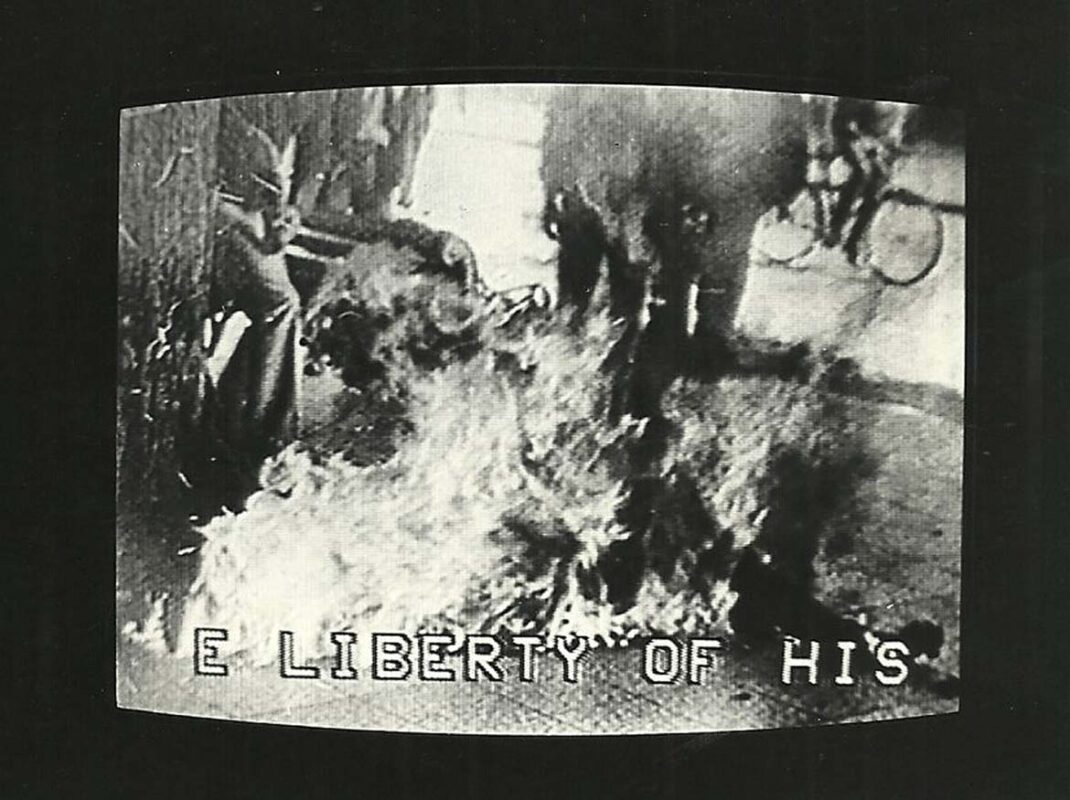
Conceived as a tribute to those who perished during the Chilean dictatorship, this work begins with a press photograph capturing the moment in 1983 when worker Sebastián Acevedo self-immolated in front of the Cathedral of Concepción, demanding the release of his children detained by the secret police. The reference to this event, which deeply shook Chilean society, is interwoven with images of Rosenfeld’s intervention in Valparaíso, where, as Diamela Eltit wrote, the repetition of the + sign evokes a funeral wake.
¡Ay de los vencidos! (1985) 2’20’‘
This video refers to interventions Rosenfeld performed at the entrance to the El Tololo international astronomical observatory in northern Chile and at a NASA tracking station. An initial image related to space exploration is intertwined with others that link the transplanetary with the earthly through a dizzying oscillation of the camera, while a female voice echoes the word «no.» The title recalls the Latin phrase Vae victis (“woe to the vanquished”), evoking the helplessness of the defeated and leaving room for interpretation of the piece’s targets.
Cautivos (1989) 10’54»
Originally conceived as a video installation, this work was presented in an unfinished building that was once intended to be the largest public hospital in Latin America under President Salvador Allende. A line of fire drawn by the artist in Santiago opens the video, whose images unfold in vertical and horizontal bands forming a cross. Footage from various art actions by Rosenfeld is interwoven with television archives referring to the 1989 plebiscite that marked Chile’s return to democracy, along with segments from media trials such as that of political prisoner Karin Eitel.
Sobreseimiento (1993) 2’19»
On February 8, 1991, Chile’s National Commission for Truth and Reconciliation officially delivered the Rettig Report on human rights violations under the Pinochet dictatorship. Using the case of DINA (National Intelligence Directorate) agent Luisa Lagos, aka Liliana Walker, Rosenfeld explores the concept of acquittal, symbolically insisting on the repetition of the same scene.
Operaciones (1996) 2’19»
Based on the testimony of a trans person, Rosenfeld addresses the semantic gap between the economic operations of elites who celebrate capital accumulation and those forced by precariousness to pawn their belongings to survive. In this polarization of life conditions under neoliberalism, the central figure embodies a third meaning of «operations»—not just surgical transition, but the possibility of dissent through gender change.
By Pass (1997) 4’49»
This piece contrasts footage of a brutally archaic animal slaughter in Uruguay’s periphery with the vacant gaze of a dying eye in a euthanasia process. Between club swings and the white of the eye, Rosenfeld’s cinematic operation focuses on bypass as a means of survival through the power of images to generate new meanings. Simultaneously, the audio unfolds a fragmented poetics, full of Chilean colloquialisms, reinforcing the multiplicity of meanings in Rosenfeld’s work.
El empeño Latinoamericano (1998) 7’18»
In this video, Rosenfeld once again addresses the theme of unequal economies explored in Operaciones. Within the same visual space appear: an individual pawning possessions out of desperation; the frantic, fluctuating numbers of neoliberal stock markets; and a body transformed through gender-confirming surgery. The title plays on the dual meaning of empeño—as both pledge and determination—emphasizing Latin America’s forced persistence in sustaining an exhausting economic system. The soundtrack, composed of guttural female vocalizations, adds to the dizzying circulation of goods, bodies, and objects in a process where neoliberal present and its relentless momentum intertwine.
¿Quién viene con Nelson Torres? (2001) 13’59»
Here, Rosenfeld interrogates how language and learning function as disciplinary forms that mold individuals to be more docile and functional, referencing the dominant structures of public, political, and cultural orders. Based on a free adaptation by Diamela Eltit of a scene from Peter Handke’s Kaspar, the video stages a stripper, a deaf-mute woman, a drug addict, and his mother—intercut with footage of riots and looting from Latin American uprisings.
La Guerra de Arauco (2001) 6’21»
This video reflects the historic dispute over land between the Mapuche people and the Chilean state—a cultural, political, and human conflict dating back to the Spanish conquest. The looping repetition of extractivist imagery contrasts with the outraged reaction of a Mapuche woman to the plunder. In the montage, Rosenfeld includes audio of a woman reading one of the first ethnolinguistic texts published in Chile in Mapudungun, while reflecting on the historical and current plight of her people. Rosenfeld deliberately omits a Spanish translation as a gesture reaffirming her opposition to all forms of submission